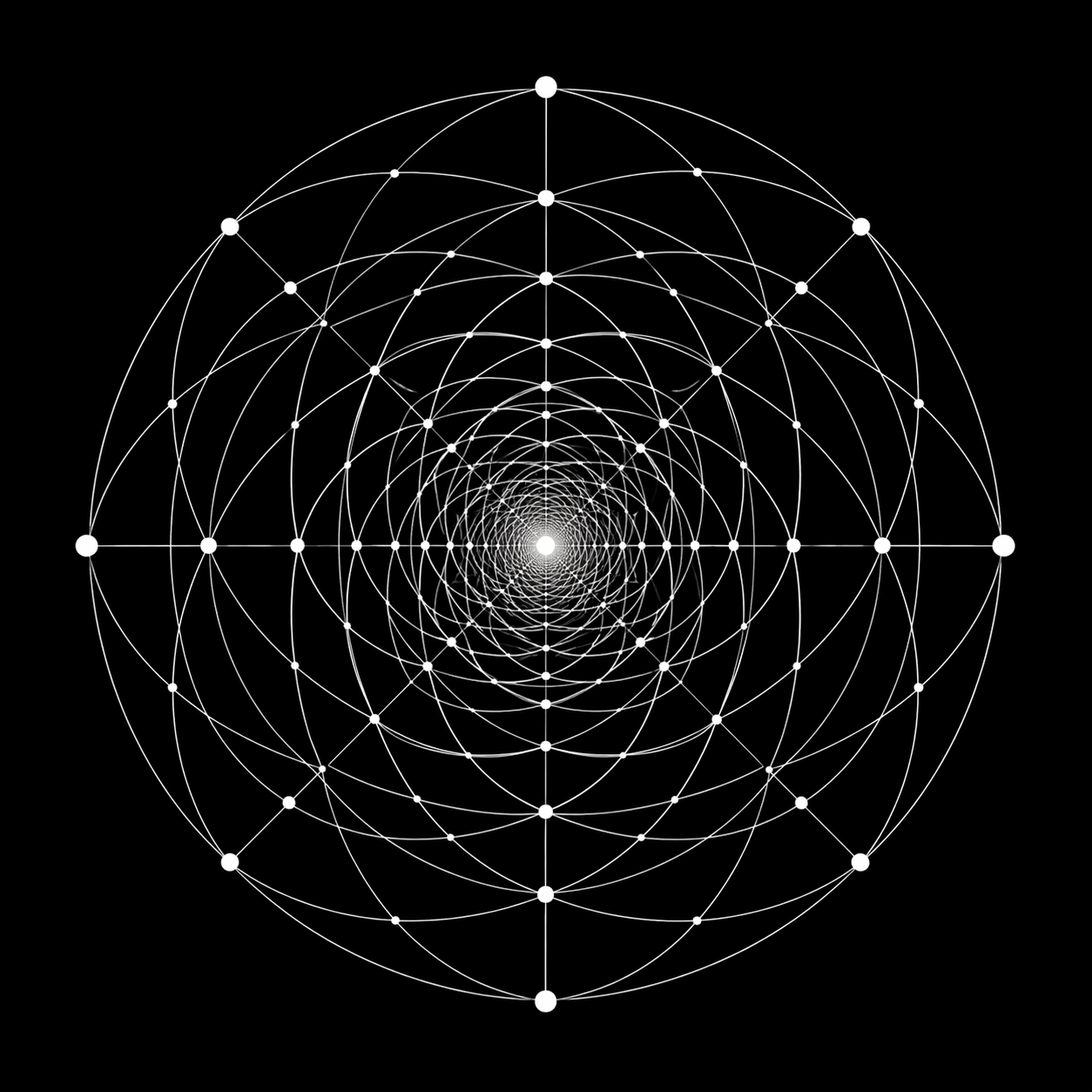
A guide to the complete calculation

From ZS to coupled closure.

The mathematics is a connected process: build a state, determine its permitted structure, evolve the coupled response, and check what can return consistently.

Read in dependency order

The process, not a collection of isolated results.

This outline follows the current paper through its completed development. Execution order describes mathematical dependencies; it is not automatically a literal chronology of the physical universe.

  1. Reference and information state

    Start with ZS, the admissible kernel, normalized spherical information states and their correlations. Keep the reference construction distinct from a selected physical energy or length scale.

  2. Symmetry and effective physics

    Build the permitted representations and impose positivity, stability, gauge and Lorentz constraints. Carry the same conventions into later calculations.

  3. Microscopic coefficient structure

    Develop the period, theta, kernel and light-Higgs calculations that feed flavor and neutrino structure. Separate structural rank and selection results from independently fixed numerical masses and couplings.

  4. Recursive geometry and local structure

    Resolve cones, slant intersections, layers and parent–child connections. Rotation, local motion, deformation and exchange belong to the evolving geometry rather than a frozen spherical drawing.

  5. Structural matter and gravity

    Classify the generated modes and evaluate localization, scale, stress and gravity responses. The 25-entry Standard Model structural ledger and 12 additional broken X/Y directions have distinct counting scopes.

  6. Common-action quantum response

    Connect charged fields, currents, retarded response, stress, renormalization and gravity. Source ownership and reciprocal response prevent the same contribution from being counted twice.

  7. Moving interfaces and environmental balance

    Identify the actual child, layer and parent regions in the evolving state. Apply matching, endpoint response and breathing to those regions, including the motion and exchange terms owned by the current calculation.

  8. Return, restart and integrated decisions

    Carry compatible information through the recursive return and ZS restart. Reconcile the current outputs, their provenance, observable forecasts and declared no-go or open boundaries.

Internal Item #8

Three regions. One evolving state.

Relationship diagram—not a numerical simulation or a drawing of measured cosmic structure.

What is connected

The native moving regions share the calculated field, stress and geometry response. Common rotation and local motion are retained; matching and breathing are tested on the coupled state.

Cone-center and polar exchange belong to this transport structure. The manuscript does not establish that this is an observed gamma-ray-burst mechanism.

What the closure means

The final internal Item #8 decision is PASS for the specified native parent–layer–child construction. Responsive boundaries are not incorrectly required to behave like fixed endpoints.

This internal decision is distinct from the external axion-coverage question that also carries an Item #8 label.

Counting without overclaiming

Structural identities are not measured masses.

25 SM structural entries

12 + 12 + 1

Twelve gauge directions, twelve fermion-species slots and one Higgs-core entry. This is the manuscript’s structural accounting convention.

12 additional directions

Broken X/Y sector

The broken-SU(5) directions are recorded separately. They are not twelve discovered particles or twelve independently measured masses.

Observable interpretation

Identity → dynamics → test

A structural match must still be distinguished from numerical mass selection, signal strength and an independent experimental observation.

Follow the evidence to its final scope.

The paper’s final reconciliation—not an earlier intermediate branch—governs the claims summarized here.

Final results and boundaries