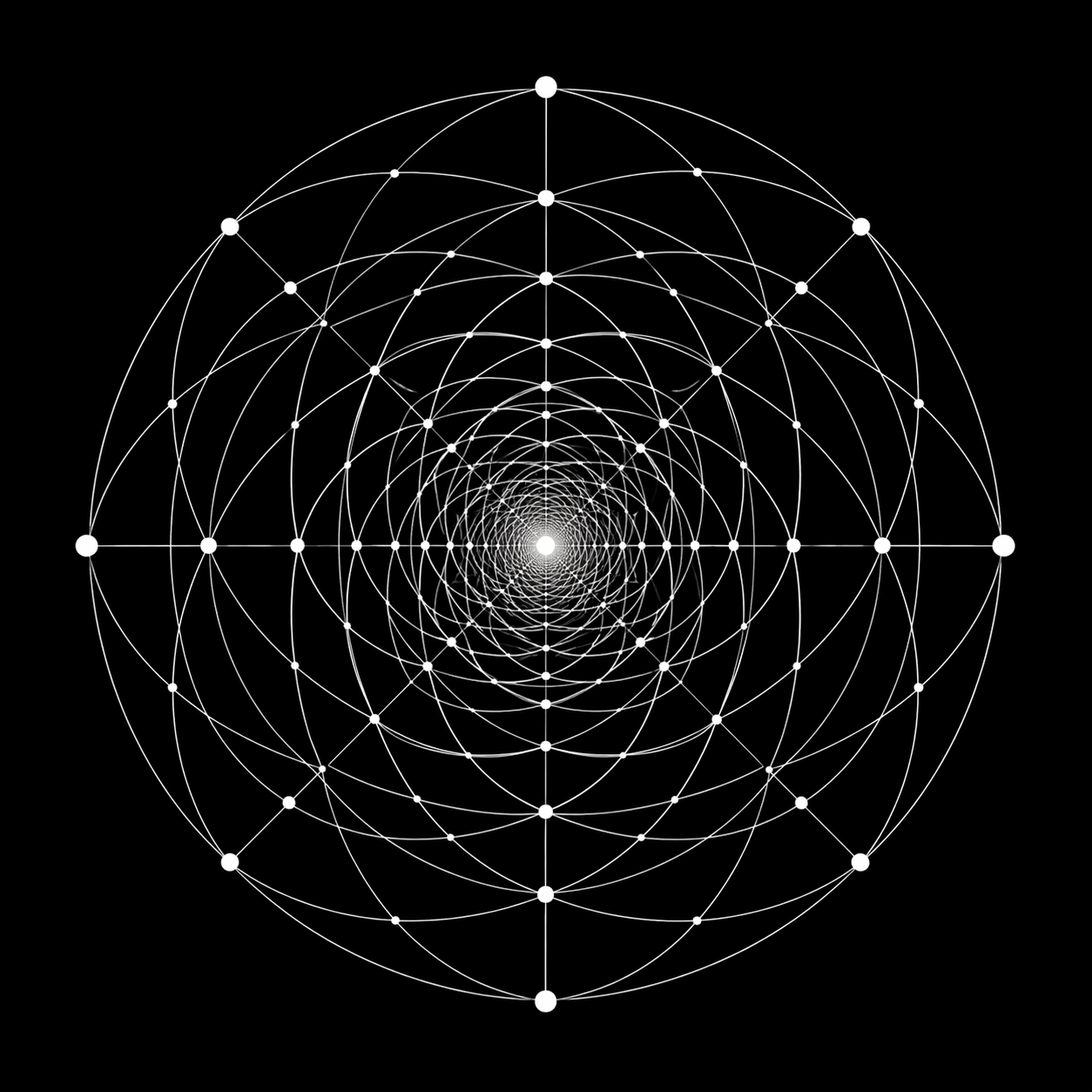
ZS — Zero State
ZS supplies the distinguished neutral reference, the initial quadratic construction and the starting kernel. Reference-state normalization does not by itself select a physical mass, clock or gauge coupling.
UTFANSWF Proper is a UPOE: a Unified Physics Operating Environment. It connects compatible states, information and constraints without erasing the local physics of each discipline.
The five-layer construction
ZS supplies the distinguished neutral reference, the initial quadratic construction and the starting kernel. Reference-state normalization does not by itself select a physical mass, clock or gauge coupling.
SWF–ISM constructs normalized information states with spherical harmonics, entropy and correlation structure. These are the objects carried into later geometry and response calculations.
ANSWF provides the low-energy effective-field-theory baseline and the maps used to check positivity and admissibility. Standard physical results retain their own assumptions.
SANSWF organizes representations and imposes Lorentz and gauge consistency, bounded-from-below stability and unitarity. A passed consistency condition is not a new measurement.
The coupled environment carries fields, stress, geometry and response between sectors. Common-action evolution, moving interfaces and parent–child exchange are evaluated with explicit ownership and final acceptance criteria.
How the connections stay meaningful
Connected calculations must refer to the same evolving state, rather than combine individually successful but unrelated snapshots.
A parameter supplied by a dataset, initialization or another calculation remains identified as such. Reuse does not turn an input into an independent prediction.
Local consistency feeds the coupled decision. A final result must include the relevant matching, conservation, stability and response conditions.
Current manuscript scope
The paper identifies 28 computational disciplines and two formal disciplines. The grouping below preserves that distinction; coverage is not a claim that every open problem in each subject has been solved.
Electrodynamics is included without claiming an independently selected absolute electromagnetic normalization. String-theory calculations concern the specified constructions, not a uniquely selected vacuum. “Observer” denotes a mathematical or control role; it does not establish consciousness.
What “unified” means here
General relativity, quantum field theory, effective field theory, cosmology and unified-model constructions retain their domain-specific physics. The operating environment makes their translation rules and cross-sector dependencies inspectable.
Internal closure is meaningful at that declared scope. It does not automatically establish every particle mass, every coupling or a unique physical universe.
The manuscript develops microscopic coefficients, recursive structure, common-action response and coupled physical interfaces before reconciling predictions.
Trace the full process